Mitsubishi Engines Manuals provide in-depth technical documentation for various Mitsubishi engines, empowering users to perform maintenance, diagnostics, and repairs with precision. These manuals cover a wide range of engines, including automotive, industrial, and marine applications, offering comprehensive guidance on engine disassembly, assembly, troubleshooting, and performance optimization.
Mitsubishi Engines Manuals stand out for their technical accuracy, detailed illustrations, and step-by-step instructions. They provide valuable information on engine specifications, torque values, wiring diagrams, and diagnostic codes, enabling users to identify and resolve issues efficiently. Whether you're a professional mechanic, an avid DIY enthusiast, or simply seeking to gain a deeper understanding of your...
Mitsubishi Engines Manuals provide in-depth technical documentation for various Mitsubishi engines, empowering users to perform maintenance, diagnostics, and repairs with precision. These manuals cover a wide range of engines, including automotive, industrial, and marine applications, offering comprehensive guidance on engine disassembly, assembly, troubleshooting, and performance optimization.
Mitsubishi Engines Manuals stand out for their technical accuracy, detailed illustrations, and step-by-step instructions. They provide valuable information on engine specifications, torque values, wiring diagrams, and diagnostic codes, enabling users to identify and resolve issues efficiently. Whether you're a professional mechanic, an avid DIY enthusiast, or simply seeking to gain a deeper understanding of your Mitsubishi engine, these manuals serve as an essential resource, ensuring optimal engine performance and longevity.
This manual covers the [Vehicle Make] [Vehicle Model], a versatile vehicle designed for [Intended Usage]. Engineered for exceptional performance and durability, the [Vehicle Model] combines advanced technology with robust construction, making it a reliable choice for [Notable Features]. Its commitment to quality ensures a superior driving experience and long-term value for its owners.
This manual covers the 1987 Mitsubishi Pick-Up, a compact pickup truck known for its reliability, rugged construction, and affordable pricing. This model, identified by chassis code L030P, was a strong competitor in its segment, offering capable performance, particularly with its available 4WD system. The 1987 model year represents the second generation of this truck, featuring a redesigned chassis and body, updated engines such as the 2.0L 4G53 inline-4, and improved interior comfort. Its straightforward engineering and durable build have made it a lasting choice for utility and off-road use.
This manual provides comprehensive service and repair information for the 1987 Mitsubishi Pickup, covering all models and engines. Designed with the same detail provided to professional service technicians, this guide ensures you have the resources to maintain and repair your vehicle effectively. Its extensive coverage reflects the engineering quality and reliability expected of this model, offering detailed procedures and specifications for a wide range of components.
This manual covers the [Vehicle Make] [Vehicle Model], a versatile and robust vehicle designed for [Intended Usage]. Engineered for exceptional reliability and performance, the [Vehicle Model] offers a blend of advanced technology and practical functionality. Its [Notable Features] set it apart, providing an unparalleled driving experience for [Target Audience]. This vehicle represents a commitment to quality and innovation in automotive design.
This manual covers the [Make] [Model], a versatile vehicle designed for [intended usage]. Produced between [production years], this model is recognized for its [notable features], embodying a commitment to engineering excellence and enduring reliability. Its design prioritizes [unique selling points], ensuring a superior driving experience and dependable performance across various conditions.
This manual pertains to the Galant, specifically the 6th Generation (E30) models produced between 1988 and 1993. This generation is recognized for its engineering advancements, including the performance-oriented VR4 variant which featured a turbocharged engine and all-wheel-drive capabilities. The Galant offered both 4-door sedan and 5-door hatchback body styles, catering to a range of consumer needs. Known for its robust chassis codes E31 through E39, this vehicle represents a significant period in automotive history, blending everyday practicality with sporty performance, especially in its higher-trim configurations.
This manual covers the [Vehicle Make] [Vehicle Model], produced for the model years [Start Year] through [End Year]. This vehicle is engineered for [Intended Usage] and is recognized for its [Notable Features]. Its design emphasizes [Engineering Quality] and [Reliability], offering a unique blend of [Unique Selling Points] for its class.
This manual covers the Galant / Eterna VR-4, specifically the Eighth Generation (E80 Series) produced between 1989 and 1993. Known for its sophisticated all-wheel-drive (AWD) system, available four-wheel steering (4WS), and powerful turbocharged 4G63 engines, the VR-4 variant offered a compelling blend of performance, handling, and advanced technology for its time. This model represented a significant step in performance vehicle development, influencing later iconic models.
This comprehensive workshop and service manual covers Mitsubishi engines and transmissions manufactured between 1990 and 2007. It provides detailed information for a wide range of Mitsubishi models, including the 3000 GT, Eclipse, Galant, Lancer, Montero, and many others. The manual is designed to offer the same level of technical detail and accuracy as those used by dealership technicians, ensuring a complete and functional resource for maintaining and repairing these vehicles.
This manual covers the [Make] [Model] vehicles produced between [Year] and [Year]. Renowned for its exceptional engineering and unwavering reliability, this model offers a unique blend of [Notable Feature 1] and [Notable Feature 2], making it an ideal choice for [Intended Usage]. Its robust construction and advanced [System/Technology] underscore a commitment to performance and durability, ensuring a superior driving experience.
This manual covers the [Vehicle Make] [Vehicle Model], a versatile and robust vehicle designed for a wide range of applications. Produced between [Production Start Year] and [Production End Year], this model is renowned for its exceptional engineering, dependable performance, and innovative features that enhance both driving experience and utility. Its construction prioritizes durability and efficiency, making it a reliable choice for everyday commuting, challenging terrains, and demanding professional use. The [Vehicle Model] represents a commitment to quality and advanced automotive technology, offering a blend of comfort, power, and practicality.
The 1993 Mitsubishi 3000GT (model code Z16A), also known in North America as a Dodge Stealth twin, is a performance-oriented Grand Tourer coupe engineered with advanced technology and aerodynamic styling. This model represents a pinnacle of Japanese sports car design for its era, competing with other high-performance vehicles of the time. Notable innovations include optional four-wheel steering and advanced electronic systems, underscoring its commitment to cutting-edge automotive engineering and a dynamic driving experience.
The 1993 Mitsubishi 3000GT, also known as the GTO in Japan, represents a pinnacle of Japanese sports coupe engineering for its era. This flagship model was designed to compete with the best performance vehicles globally, incorporating advanced technologies such as optional all-wheel-drive, active four-wheel steering (AWS), and optional active aerodynamics. Powered by robust V6 engines, including naturally aspirated and twin-turbocharged variants, the 3000GT offered a compelling blend of performance, sophisticated handling, and cutting-edge features, solidifying Mitsubishi's reputation for innovation and engineering prowess.
This manual covers the [Make] [Model], a versatile vehicle designed for [intended usage]. Renowned for its exceptional engineering, the [Model] offers a blend of performance, comfort, and reliability, making it an ideal choice for [notable features]. Built to the highest standards, this vehicle exemplifies [engineering quality] and is engineered for durability and a superior driving experience.
This service manual provides comprehensive guidance for the Mitsubishi Engine 4D56, covering models from 1994 onwards. Designed for robust performance and reliability, the 4D56 engine is a testament to Mitsubishi's engineering quality, offering dependable operation for a wide range of applications. This manual ensures that owners and technicians have the necessary information to maintain and repair this engine effectively.
The 1994 Mitsubishi Expo LRV is a compact MPV designed for families and individuals seeking versatile utility. Built on a shared platform with other Mitsubishi compact vehicles of its era, it offers a surprising interior volume within its compact dimensions, featuring versatile seating arrangements for five to seven passengers. Available with front-wheel drive or optional All-Wheel Drive (4WD), the Expo LRV was powered by a 2.4-liter DOHC inline 4-cylinder engine producing approximately 135-145 horsepower. Its unique selling points included its practical design and the availability of AWD, positioning it as a competitive option against contemporaries like the Honda Odyssey and Toyota Previa.
This manual covers a comprehensive range of transmissions manufactured between 1996 and 2005, including various manual and automatic gearboxes for both Front Engine Front Drive (FF) and Front Engine Rear Drive (FR) layouts. It addresses specific transmission codes such as F4M21, F5M21, F5M31, W5M31, KM182, R4M21, V5M21, R4AW2, V4AW4, and F5M42, among many others. This extensive coverage ensures that owners and technicians working on a wide array of models from this era, equipped with these diverse transmission types, have access to the necessary technical information. Engineering during this period emphasized reliability and performance, and this manual provides the factory-level detail to maintain that quality.
The Mitsubishi L200, specifically the Third Generation (K60/K70 chassis codes), is a robust and practical compact pickup truck renowned for its durability, reliability, and capable off-road performance. Produced from 1997 to 2005/2006, this versatile vehicle was offered in various body styles including Single Cab, Club Cab, and Double Cab configurations, catering to a wide range of utility and personal needs. It was equipped with a selection of efficient diesel engines, such as the 2.5L 4D56 and the 2.8L 4M40, alongside less common gasoline V6 options. The L200's strengths lie in its sturdy construction, dependable powertrain options, and its ability to handle demanding tasks, making it a competitive choice in the pickup truck market against rivals like the Toyota Hilux and Nissan Frontier.
The Mitsubishi L200, also known as the Triton in certain markets, represents the Third Generation (K60/K70 Series) produced from 1996 to 2005. This robust mid-size pickup truck was engineered for durability and versatility, making it a popular choice for both commercial and recreational use. Notable features include its durable ladder-frame chassis, comfortable coil-spring independent front suspension, and the advanced Super Select II 4WD system available on many models. Renowned for its reliability and longevity, the L200 offered a capable platform with powerful diesel engine options, including the 2.5L 4D56 and 2.8L 4M40, which were celebrated for their efficiency and toughness.
This manual covers the Mitsubishi L200, Third Generation (K60/K70 Series), produced from 1997 to 2002. Known for its ruggedness, off-road capability, and reliability, this compact pickup truck was designed for both work and recreation. The L200, also marketed as the Triton in many regions, offered various body styles including single cab, extended cab, and double cab, with gasoline and diesel engine options. Its design philosophy balanced improved aerodynamics with robust construction, making it a capable utility vehicle.
This manual covers the [Make] [Model] vehicle, produced for the [Production Years] model years. Renowned for its [Notable Features], this vehicle is engineered for [Intended Usage], combining robust construction with exceptional reliability. Its design prioritizes [Unique Selling Points], ensuring a superior driving experience and long-term performance.
This manual covers the Mitsubishi Triton, also known as the L200, specifically the K60/K70 Series produced between 1997 and 2002. These vehicles have been recognized for their robust engineering and versatility, offering a range of body styles including DualCab, Ute, and Trayback configurations. Available with various engine options from 2.0L to 3.5L, including naturally aspirated petrol and turbocharged diesel variants, and offered in both 2WD and 4WD, the Triton/L200 has established a strong reputation in the global pickup truck market. The legacy in producing durable light commercial vehicles is evident in this generation, which provided enhanced comfort and safety features.
The Mitsubishi Triton, also known as the L200, represents the third generation (K60/K70 series) of Mitsubishi's robust and globally recognized compact pickup truck. Produced from 1997 to 2002, this versatile vehicle is renowned for its rugged construction, off-road capability, and durability, making it a popular choice for both work and adventure. Available in various body styles including Single Cab, Club Cab, and Double Cab, and offered with a range of efficient diesel and capable petrol engines, the Triton/L200 was engineered to meet diverse market demands, solidifying Mitsubishi's reputation for producing reliable utility vehicles.
This manual covers the [Make] [Model], a versatile vehicle designed for [intended usage]. Produced between [production years], this model is recognized for its [notable features], embodying a commitment to engineering excellence and dependable performance. Its robust construction and innovative design ensure a superior driving experience, making it a reliable choice for [target audience].
This manual covers the [Vehicle Make] [Vehicle Model], a versatile and robust vehicle designed for [Intended Usage]. Engineered for exceptional reliability and performance, the [Vehicle Model] offers a blend of [Notable Feature 1] and [Notable Feature 2], making it an ideal choice for [Target Audience]. Its commitment to quality construction ensures a dependable driving experience across a range of conditions.
This manual covers the [Vehicle Make] [Vehicle Model], a versatile and dependable vehicle designed for a wide range of applications. Engineered with precision and built for longevity, the [Vehicle Model] offers a blend of performance, comfort, and advanced technology. Its robust construction and thoughtful design ensure a superior driving experience, making it an ideal choice for both daily commuting and more demanding journeys.
The 2002 Mitsubishi Pajero, also known as the Montero in certain markets, is a robust mid-size SUV renowned for its exceptional off-road capability and enduring reliability. Built on a durable body-on-frame chassis, this generation of the Pajero offers a commanding presence and impressive utility, making it suitable for both daily driving and demanding off-road adventures. Available with a range of powerful V6 gasoline engines or an efficient turbocharged diesel, and featuring the advanced Super Select II 4WD system on select trims, the Pajero was engineered to tackle diverse terrains with confidence. Its spacious interior, coupled with a legacy of ruggedness reinforced by multiple Dakar Rally victories, solidifies the Pajero's status as a capable and dependable vehicle.
The Mitsubishi Galant, produced between 2004 and 2007, represents a significant entry in the mid-size sedan market, known for its comfortable ride and available V6 engine options. This generation, often referred to by its chassis code E1_A, offered a blend of practicality and style, competing with established models in its segment. Key features included advanced safety systems for its time, such as standard Anti-lock Braking System (ABS) and front airbags, with optional side and curtain airbags on higher trims. The Galant was designed to provide reliable transportation for daily commutes and family use, featuring a well-appointed interior and a robust chassis engineered for stability and passenger comfort.
The Mitsubishi 380, produced from 2005 to 2008, is a mid-size sedan engineered with a focus on ride comfort and Australian market suitability. Built on a platform that replaced the successful Magna, this vehicle features a naturally aspirated 3.8-liter V6 petrol engine, delivering approximately 170 kW of power. Known for its distinctive styling and spacious interior, the 380 aimed to be a competitive offering in its segment, balancing everyday practicality with a comfortable driving experience. Its robust construction and Australian-specific tuning contributed to its reputation for reliability.
Welcome to the comprehensive workshop service repair manual for the Mitsubishi Galant, covering model years 2004 through 2007. This manual provides in-depth information for all Galant models and engines from these production years, including chassis codes CY3A, CY4A, and CY6A. Known for its solid engineering and comfortable ride, the Galant was a competitive mid-size sedan of its era, often compared to segment leaders like the Honda Accord and Toyota Camry. This manual is designed to be an indispensable resource for maintaining and repairing your vehicle, ensuring its optimal performance and longevity.
The Mitsubishi 380, produced between 2005 and 2009, was a mid-size sedan designed as a comfortable and well-equipped family vehicle, primarily for the Australian and New Zealand markets. This generation, spanning the DB and DB Series II models, featured a robust 6G75 V6 SOHC MPI engine, independent front and rear suspension, and a suite of safety features for its era, including front and side airbags, ABS, and EBD. Known for its spacious interior and a focus on refinement, the 380 aimed to provide a compelling alternative in a competitive segment, offering a blend of performance and practicality.
The 2006 Mitsubishi Eclipse, part of the Third Generation (D50A) with chassis code D52P3, is a sporty compact coupe and convertible known for its distinctive styling and available V6 power. This model aimed to capture the attention of younger buyers and enthusiasts seeking a visually striking vehicle with engaging performance. Its design features a notable 'cab-forward' aesthetic, an optional convertible body style, and an interior that complements its sporty exterior. The Eclipse offered a choice between a 2.4L 4-cylinder engine and a more potent 3.0L V6, providing options for different performance preferences.
The Mitsubishi Triton/L200, representing the fourth generation (KA/KB series) produced in 2006, is a highly capable pickup truck renowned for its durability and versatility. This model has established a strong global presence, competing effectively in its segment through robust engineering and reliable performance. Whether utilized for demanding work tasks or recreational adventures, the Triton/L200 is engineered to meet a wide range of user needs, offering a blend of utility and dependable operation that has made it a favored choice across various markets.
The Mitsubishi 3000GT, produced from 1991 to 1999, stands as a premium grand tourer and sports car, renowned for its advanced engineering and performance. This model, identified by chassis code Z16A and engine code 6G72, offered cutting-edge features such as an active aero system with adjustable spoilers, all-wheel drive (AWD), all-wheel steering (AWS), and electronically controlled suspension (ECS). Available with a 3.0-liter V6 engine in naturally aspirated or twin-turbocharged configurations, the 3000GT competed with notable vehicles like the Nissan 300ZX and Toyota Supra. Its inclusion on Car and Driver's Ten Best list for 1991 and 1992, and Motor Trend's Import Car of the Year for 1991, underscore its significant impact and technological prowess during its production run.
This manual covers the 3000GT VR4, GTO Twin Turbo, and its North American counterpart, the Stealth R/T Turbo, produced from 1990 to 1999. These performance-oriented sports cars are renowned for their sophisticated engineering, featuring a twin-turbocharged 6G72 V6 engine, advanced All-Wheel Drive systems with Active Center Differential, and for some models, Active Rear Wheel Steering and Active Aerodynamics. With their powerful drivetrains, including Getrag 5-speed and 6-speed manual transmissions, and a focus on cutting-edge technology for their era, these vehicles represent a significant chapter in automotive performance.
This manual covers the [Make] [Model] vehicle, produced between [Year] and [Year]. This vehicle is engineered for [Intended Usage] and is recognized for its [Notable Features], [Engineering Quality], and [Reliability]. Its design prioritizes [Unique Selling Points], making it a distinguished choice in its class.
This manual covers the [Vehicle Make] [Vehicle Model], a versatile vehicle designed for [Intended Usage]. Known for its robust engineering and dependable performance, the [Vehicle Model] offers a blend of [Notable Feature 1] and [Notable Feature 2], making it a distinguished choice in its class. Its construction prioritizes both durability and driver comfort, ensuring a superior ownership experience across various conditions and applications.
This manual covers the Mitsubishi 4M41, an internal combustion diesel engine designed for service and repair applications. The Mitsubishi 4M41 is recognized for its robust engineering and reliability, making it a dependable choice for various operational needs. This official certified service and repair manual provides comprehensive guidance for maintaining and servicing this engine.
This document provides comprehensive service information for the Mitsubishi 6G72 engine. Engineered for reliability and performance, the 6G72 engine represents a significant advancement in automotive powerplants, designed to meet the demands of various applications. Its robust construction and advanced technology ensure efficient operation and longevity, making it a preferred choice for discerning users.
This service and repair manual provides comprehensive information for Mitsubishi engines, specifically the 6G72 model. It is designed to be the same resource used by dealership technicians, ensuring that owners and service professionals have access to the highest level of detail for maintaining, servicing, diagnosing, and repairing the vehicle. This manual covers a wide array of systems, reflecting the intricate engineering and reliability expected from Mitsubishi vehicles.
This document provides comprehensive information for engines, specifically covering the W-E and E-W series. It details a wide range of engine models including the 4G1, 4G3, 4G5, 4G6, 4G9, 6G7, 6A1, 4D5, 4D6, 4M4, 6D7, F8QT, and F9Q. The manual addresses various engine types such as CARBURETOR, MPI, DIESEL, and ENGINE ELECTRICAL systems, offering in-depth technical data for these components.
This manual provides comprehensive technical information for the Rosa Bus, specifically covering models BE and BE6. Designed for dealership mechanics, this factory service manual details the operation and repair of vehicles equipped with the 4M5 4.9L Turbodiesel and 4D3 3.9L Turbodiesel engines. The Rosa Bus is engineered for reliable performance, offering robust construction and efficient operation suitable for passenger transport.
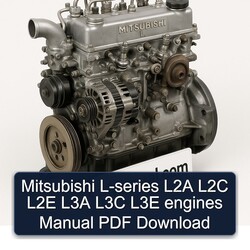
This manual covers Mitsubishi L-series engines, specifically models L2A, L2C, L2E, L3A, L3C, and L3E. These engines are known for their robust engineering and reliability, making them a trusted choice for various applications. This comprehensive guide provides detailed information to ensure optimal performance and longevity of your Mitsubishi L-series engine.
This workshop repair service manual covers all Mitsubishi L-series models. Engineered for reliability and performance, these vehicles are designed to meet a variety of automotive needs. The L-series is equipped with multiple engine options, including the L2A, L2C, L2E, L3A, L3C, and L3E, ensuring a suitable configuration for different applications. This manual provides comprehensive information to understand and maintain the quality inherent in Mitsubishi engineering.
This workshop repair service manual covers the Mitsubishi L-series Diesel Engine for all models. Engineered for reliability and performance, these diesel engines are known for their robust construction and efficient operation. This manual is designed to provide comprehensive information for understanding, maintaining, and repairing your L-series Diesel Engine, ensuring its longevity and optimal functionality.
This manual provides comprehensive information for vehicles equipped with the 4G6 Series engines, covering production years from 1990 to 2004. The 4G6 family, known for its robust inline-four cylinder design, includes variants such as the 1.8L 4G61, 2.0L 4G62, the performance-oriented 2.0L 4G63 (including the highly regarded turbocharged 4G63T), and the 2.4L 4G64. These engines were utilized across a diverse range of models, including the Lancer, Eclipse, Galant, and Outlander. Their design philosophy emphasizes durability and performance potential, with available SOHC and DOHC configurations, some featuring MIVEC technology. This resource is an essential tool for anyone involved in full engine rebuilds, head gasket repairs, or timing belt and chain replacements, ensuring the longevity and optimal performance of these versatile powertrains.
This manual covers the Mitsubishi S4S and S6S Diesel Industrial Engines. These engines are known for their robust construction and reliable performance, making them suitable for demanding applications. The S4S model features a 2.6-liter displacement with 4 cylinders, while the S6S offers a 3.9-liter displacement with 6 cylinders. Both engines are typically naturally aspirated and designed for durability in heavy-duty industrial environments.
This manual covers the Mitsubishi SQ-Series S4Q and S4Q2 Diesel Engines, a line of reliable diesel engines manufactured by Mitsubishi. These engines are engineered for robust performance and are intended for standard specification use in various industrial applications. Their design emphasizes durability and efficiency, making them a dependable choice for demanding operational environments.
This comprehensive service manual covers a wide range of Mitsubishi transmissions, including various manual, automatic, and continuously variable transmission models. It details transmissions such as the FF (W-E) Manual Transmission series (F4M21, F5M21, F5M22, F5M31, F5M33, W5M31, W5M33, KM182, W5MG1, W6MG1), FF (W-E) Automatic Transmission series (F3A2, F4A2, F4A3, W4A3), FR (W-E) Manual Transmission series (R4M21, R5M21, V5M21, V5MT1, R5M3, V5M3), FR (W-E) Automatic Transmission series (R4AW2, V4AW2, R4AW3, V4AW3, V4AW4, R4A51, V4A51, V5A51), FF (E-W) Manual Transmission series (F5MR1, F5MR2, F5MR3, F5M41, F5M42, W5M42, F5M51), and FF (E-W) Automatic Transmission series (F4A4, F4A5). This manual is designed to provide detailed information for maintaining and repairing these essential vehicle components.
This manual covers the Mitsubishi Triton L200, also known as the Triton / L200, from the Third Generation (K50/K60/K70) produced between 1997 and 2002. This robust pickup truck is renowned for its ruggedness, durability, and versatility, serving effectively as both a workhorse and a recreational vehicle. Available in various body styles including Single Cab, Club Cab, and Double Cab, and in both 2WD and 4WD configurations, the Triton L200 offers a range of engine options, including the 4D56 2.5L Turbo Diesel, 4M40 2.8L Turbo Diesel, and V6 petrol engines like the 6G72 3.0L and 6G74 3.5L. Its engineering prioritizes capability in challenging conditions and reliability, making it a trusted choice in its segment globally.