The Beaulieu category encompasses a range of specialized cameras designed for professional and enthusiast photographic applications. These devices are known for their robust construction, advanced optical systems, and precise control mechanisms, making them suitable for demanding shooting conditions and creative photographic pursuits. Their common applications include documentary filmmaking, artistic photography, and scientific imaging, where image quality and reliability are paramount.
Documentation for Beaulieu cameras typically includes detailed user manuals, service and repair guides, and technical specification sheets. These resources provide essential information on camera operation, maintenance schedules, troubleshooting common issues, and understanding the full capabilities of the equipment. They are critical...
The Beaulieu category encompasses a range of specialized cameras designed for professional and enthusiast photographic applications. These devices are known for their robust construction, advanced optical systems, and precise control mechanisms, making them suitable for demanding shooting conditions and creative photographic pursuits. Their common applications include documentary filmmaking, artistic photography, and scientific imaging, where image quality and reliability are paramount.
Documentation for Beaulieu cameras typically includes detailed user manuals, service and repair guides, and technical specification sheets. These resources provide essential information on camera operation, maintenance schedules, troubleshooting common issues, and understanding the full capabilities of the equipment. They are critical for photographers, technicians, and repair personnel to ensure optimal performance and longevity of these sophisticated imaging devices.
This manual pertains to the Beaulieu 1008XL, a Super 8 film camera designed for capturing motion pictures. This model features automatic film loading, a TTL reflex viewfinder, and automatic exposure control managed by a built-in light meter. It supports various frame rates, including 18 fps, 24 fps, and slow motion, and utilizes an electric motor for film transport. The camera is equipped with an interchangeable lens mount, typically a C-mount, and often came with a zoom lens such as an 8-48mm f/1.8. Its manual focus and silent film capabilities, along with a compact, handheld design, make it suitable for a range of filming applications.
This manual pertains to the Beaulieu 2008S Super 8, a mechanical device designed for capturing film. As a Super 8 camera, it utilizes a specific film format and operates with a mechanical motor, offering manual focus and through-the-lens viewfinder capabilities. Its design emphasizes a mechanical approach to filmmaking, likely intended for enthusiasts and creators who appreciate precise control over their visual medium.
This manual pertains to the 4008 ZM 2 Super 8 Movie Camera. This model represents a sophisticated piece of equipment designed for high-quality film capture. Its engineering emphasizes precision and reliability, offering features such as interchangeable lens capability, a versatile zoom range with the included lens, and multiple filming speeds to accommodate various creative and technical requirements. The camera's through-the-lens metering system, powered by a CdS cell, ensures accurate exposure control, while manual focus and a pistol grip trigger provide intuitive operation for capturing silent films.
This manual pertains to the 4008 ZM Super 8 camera, a notable device designed for Super 8 film enthusiasts. While specific production years are not detailed, its Super 8 format and features like a built-in light meter, electric drive motor, and power zoom lens suggest it originates from the era when Super 8 filmmaking was prevalent. The camera is equipped for standard filming with manual focus control, offering a robust platform for capturing motion pictures. Its engineering reflects the quality expected from Beaulieu, aiming for reliability and user-friendly operation within its category.
The Beaulieu 5008S MULTISPEED is a Super 8mm film camera designed for filmmaking. This model offers variable operating speeds and sound recording capabilities, enhancing its versatility for creative projects. It features a bayonet lens mount and a built-in light meter for automatic exposure control, alongside manual focus and cartridge loading for Super 8 film. The camera is powered by D-Cell batteries for the motor and a PP3 battery for the light meter, ensuring consistent operation for capturing high-quality footage.
This manual pertains to the Beaulieu 5008S Super 8, a notable camera from the Super 8 Era. Renowned for its robust construction and advanced features for its time, the 5008S Super 8 was designed for filmmakers seeking professional-quality results. Its capabilities include interchangeable lenses, a variable aperture and focal length, automatic exposure metering, and multiple frame rates for creative shooting, including slow motion. The camera also offers manual fade-in/fade-out control and remote operation, making it a versatile tool for capturing cinematic content.
This manual pertains to the Beaulieu 6008 PRO, a Super 8 film camera renowned for its professional-grade features and robust construction. Designed for serious filmmakers and enthusiasts, the 6008 PRO offers a C-Mount lens system with interchangeable lens capabilities, electric motor drive, and both manual and automatic exposure control. Its reflex viewfinder provides accurate framing, while typical frame rates of 18 fps and 24 fps, along with sound recording options, enhance creative flexibility. The camera's durable metal alloy body and typical weight of 1-2 kg underscore its build quality, making it a reliable tool for capturing high-quality Super 8 footage.
This manual pertains to the Beaulieu MAR 8, an 8mm film camera. While specific production years are not detailed, this device represents a significant piece of vintage photographic technology. The Beaulieu MAR 8 is known for its robust construction and sophisticated engineering, characteristic of its era, offering features such as variable frame rate options and a dual drive mechanism for film advancement, catering to the needs of discerning filmmakers.
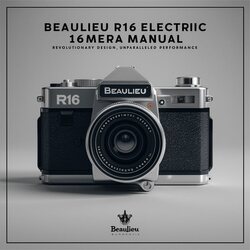
This manual pertains to the Beaulieu R16 Automatic Camera, a sophisticated imaging device designed for professional and enthusiast use. While specific production years are not detailed, its designation as an Automatic Camera suggests advanced features for its time. The R16 is recognized for its robust construction and reliable performance, offering users a high-quality tool for capturing visual media. Its automatic functionality aims to simplify operation without compromising image quality, making it a distinctive choice for photographers and filmmakers.
This manual pertains to the R16, a vintage camera renowned for its robust metal alloy construction and precision engineering. Designed for 16mm film, this silent camera features a through-the-lens reflex viewfinder, an electric motor powered by an external battery pack, and a mechanical shutter. Its versatility is enhanced by a C-mount lens system, allowing for variable lens attachments, and it typically includes an integrated exposure meter. The R16's reliable performance and quality build make it a favored choice for film enthusiasts and collectors.
This manual pertains to the Beaulieu R8/MCR8/TCR8, a line of cameras designed for 8mm film enthusiasts. These cameras are built with a durable metal body, likely aluminum alloy, and offer a range of features for creative control. They support Super 8 film formats and boast interchangeable lens capabilities with a bayonet mount. Operational features include a frame counter, manual focus, and both automatic and manual exposure control, catering to a variety of shooting preferences. While likely intended for silent film, the precise model year and specific dimensions are not detailed here.