



FJ

The Holden FJ represents a distinct era in Australian automotive history, specifically a model produced by Holden. These vehicles are passenger cars known for their classic styling and robust construction, characteristic of mid-20th century automotive design. Primarily used for personal transportation, the FJ also served as a reliable workhorse for families and businesses, embodying a blend of utility and everyday comfort that made it a popular choice during its production run. Its significance lies in its contribution to Holden's legacy as a major Australian car manufacturer.
Documentation for the Holden FJ typically includes comprehensive workshop manuals detailing maintenance schedules, repair procedures...

$16.99
The Holden 48-215, also known by its FX and later FJ model designations, represents a foundational piece of Australian automotive history. Produced from 1948 to 1956, this vehicle was Holden's inaugural passenger car, engineered in Australia with a robust chassis and powered by the reliable Holden Grey \"F\" Series engine. Its sturdy construction and functional design made it a practical choice for Australian families and a symbol of the nation's growing industrial capacity. The FX and FJ models laid the groundwork for Holden's enduring legacy, offering a dependable and accessible mode of transport that captured the spirit of the era.
$16.99
This manual covers the 48-215, also known as the FX and FJ series, produced between 1948 and 1956. These iconic Australian vehicles, available as Sedans, Coupe Utilities (Utes), and Station Wagons, represent a significant chapter in automotive history. Engineered for robustness and reliability, they were Australia's first mass-produced cars, built with a focus on durability and adaptability to local conditions. The 48-215 series, evolving into the FX and then the FJ, established the manufacturer as a leading producer, offering a dependable and accessible mode of transport that became deeply ingrained in Australian culture.
$16.99
The Holden 48-215, also known as the FX and FJ series, represents a pivotal moment in Australian automotive history, being the nation's first mass-produced automobile. Produced from 1948 to 1956, these vehicles were engineered for Australian conditions, offering robust construction and reliability. They competed effectively against imported vehicles and were instrumental in establishing Holden as a leading manufacturer. This first generation of Holden vehicles laid the groundwork for the company's future success and remains a significant part of Australia's industrial heritage, highly regarded by collectors and enthusiasts alike.
$16.99
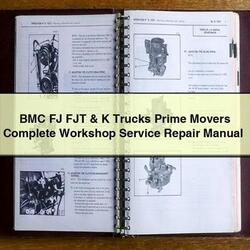
This manual covers the BMC FJ, FJT, and K Trucks Prime Movers, produced primarily from the late 1960s through the 1970s. These heavy-duty tractor units were engineered by the British Motor Corporation for demanding commercial operations. Known for their robust construction and reliability, BMC prime movers were designed to handle significant hauling capacities, featuring powerful diesel engines and heavy-duty manual transmissions. Their engineering focused on durability and operational uptime, making them a staple in commercial trucking during their production era.
$16.99
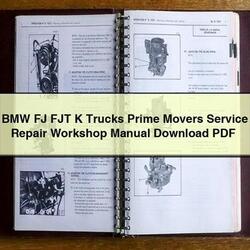
This manual covers the BMW FJ FJT K Trucks Prime Movers, a line of heavy-duty commercial vehicles engineered for demanding transport operations. While BMW is primarily known for its passenger cars and motorcycles, its involvement in the commercial sector, particularly with models like the FJ FJT K series, highlights a commitment to robust engineering and reliability. These prime movers are designed for long-haul trucking and heavy-duty applications, competing with established manufacturers in the global commercial vehicle market. The series likely offers powerful diesel engines, durable transmissions, and advanced chassis systems to ensure efficient and dependable performance under challenging conditions.
$16.99
This manual provides comprehensive information for the FX and FJ models, produced from 1948 to 1953 for the FX and 1953 to 1956 for the FJ. These vehicles represent a pivotal moment in Australian automotive history, marking the beginning of a journey as a significant manufacturer. The FX, the first car produced, was followed by the updated FJ, which incorporated styling enhancements and mechanical improvements, including a larger 'Blue Flame' engine. Both models were available in various body styles, including Saloon, Coupe Utility, and Sedan Delivery, and are celebrated for their role in post-war Australian industrial development and national identity.
$16.99
The Toyota Land Cruiser 80 Series, produced from 1990 to 1997, represents a pinnacle of full-size, body-on-frame SUV engineering, renowned for its exceptional off-road capability and legendary reliability. Built with robust drivetrains, including powerful 4.2L diesel engines (1HD-T turbocharged and 1HZ naturally aspirated), and featuring a full-time 4WD system with locking differentials, the J80 chassis (HDJ80, HZJ80) was designed for extreme durability and performance in diverse environments. Its spacious interior, coil spring suspension, and strong chassis contribute to its reputation as a highly capable and enduring vehicle, a testament to Toyota's legacy in producing dependable, go-anywhere SUVs.
$16.99
This service manual covers the Roland FJ-52 and FJ-42 HIGH FIDELITY 6 COLOR INKJET PRINTER. These models are engineered for high-fidelity color output, offering advanced inkjet printing capabilities. The manual details the technical aspects of these printers, designed for users who require in-depth knowledge for operation and maintenance.
$16.99
This manual covers the [Vehicle Make] [Vehicle Model], produced from [Start Year] to [End Year]. This vehicle is renowned for its [Notable Feature 1] and [Notable Feature 2], making it an excellent choice for [Intended Usage]. Its engineering reflects a commitment to quality and reliability, offering a unique blend of performance and practicality for discerning owners.
$16.99
This manual covers the [Make] [Model] vehicle, produced from [Year Start] to [Year End]. This model is recognized for its [Notable Feature 1], [Notable Feature 2], and [Notable Feature 3], making it a versatile choice for [Intended Usage]. Engineered for exceptional reliability and performance, the [Model] embodies [Make]'s commitment to quality and innovation, offering a superior driving experience.
$16.99
This manual covers the [Make] [Model], produced between [Year Range]. This vehicle is engineered for [Intended Usage], offering exceptional reliability and performance. Its [Notable Features] are designed to enhance the driving experience and ensure durability, reflecting a commitment to quality and innovation.
$16.99
This service repair manual covers the Sony VAIO VGN-FJ Series, a line of portable computing devices designed for everyday use. These models are characterized by their 15.4-inch displays and a typical weight of approximately 2.5-2.8 kg. They commonly feature Intel Core Duo/Solo processors, DDR2 SODIMM memory, and SATA storage interfaces, along with integrated Wi-Fi, multiple USB 2.0 ports, and VGA/S-Video outputs. The devices also typically include a DVD-RW/CD-RW optical drive and utilize a fan and heatsink cooling system.
