



Renault 5

The Renault 5 category encompasses a specific model line of compact passenger vehicles produced by Renault. These vehicles are characterized by their small footprint, economical operation, and practical design, making them suitable for urban commuting and general personal transportation. Historically, the Renault 5 has been recognized for its distinctive styling and its role as an accessible and popular choice in the European automotive market, offering a blend of utility and affordability.
Documentation for the Renault 5 model line includes comprehensive service and repair manuals detailing all aspects of maintenance, from routine fluid changes to complex engine and transmission overhauls. Technical specifications...
$16.99
This manual provides comprehensive coverage for the Renault 5 Super5, produced between 1984 and 1996. Engineered for reliability and performance, the Renault 5 Super5 is known for its practical design and efficient operation, making it a versatile choice for everyday transportation. This guide is designed to assist owners and technicians in understanding and maintaining this iconic vehicle.
$16.99
The Renault 5, specifically the Supercinq (Second Generation) produced from 1984 to 1996 under the internal model code R9, is a celebrated French supermini renowned for its modern, aerodynamic styling, spacious interior for its class, and nimble, responsive handling. This front-wheel-drive city car offered economical and practical transportation, making it a popular choice in urban and suburban environments, competing with models like the Ford Fiesta and Volkswagen Golf Mk2. Its value proposition was built on affordability in purchase and operation, coupled with reliable performance, solidifying its status as one of Renault's most successful and influential models in the supermini segment.
$16.99
This manual covers the second generation Renault 5, produced from 1984 to 1996, including hatchback body styles. This compact and practical vehicle, often known as the 'Supercinq', offered a range of engine options, typically 1.1L and 1.4L, with performance variants like the GT Turbo. Known for its efficient design and affordability, the Renault 5 was a popular choice for everyday transportation, building on Renault's heritage of producing accessible and well-engineered small cars. Its engineering quality and reliability were hallmarks of its era, making it a dependable option for owners.
$16.99
This workshop service repair manual covers the Renault 5, a celebrated supermini/city car produced from 1985 to 1996. Known for its iconic French design, agile handling, and practicality, the Renault 5 has a strong appeal to enthusiasts and owners seeking to maintain or restore these vehicles. This manual encompasses all models, engines, trim levels, and transmission types, providing comprehensive information for a wide range of variants, including the performance-oriented GT Turbo. Its engineering quality and reliability, coupled with its unique sporting image in certain configurations, have cemented its place in automotive history.
$16.99
The Renault 5, particularly the second generation often referred to as the 'Supercinq', represents a significant chapter in automotive history, produced from 1985 to 1996. This model built upon the innovative spirit of its predecessor, offering a compact, front-wheel-drive hatchback that combined practicality with engaging driving dynamics. Known for its distinctive styling and efficient packaging, the Renault 5 was designed for accessible urban and general transportation, becoming a popular choice across European markets. Its engineering quality and reliability were key factors in its widespread adoption, making it a benchmark in the supermini segment during its production years.
$16.99
This manual covers the Renault 5 and its successor, the Supercinq (Super 5), primarily for the production years 1985-1996. The Renault 5, known for its iconic design by Michel Boué and its practical, youthful appeal, established itself as a significant player in the subcompact hatchback segment. It offered a front-wheel-drive layout and a range of efficient engines, with performance variants like the Gordini and the formidable R5 Turbo achieving notable success in motorsport. This vehicle is recognized for its affordability, practicality, and the spirited driving experience it provided, making it a beloved choice for budget-conscious consumers and automotive enthusiasts alike.
$16.99
This manual covers the Renault 5, Second Generation, also known as the Supercinq (Type 122), produced from 1985 to 1996. The Supercinq represented a significant evolution from its predecessor, offering a redesigned body for improved aerodynamics and interior space, alongside a focus on comfort and modern styling. It was engineered for practicality and affordability, making it a popular choice for daily commuting and general use. The range of gasoline engines, from 1.1L to 1.7L, provided varying levels of performance, from approximately 45 hp to 95 hp, catering to diverse driver needs. This generation featured a front-wheel-drive transaxle, available with 4-speed or 5-speed manual transmissions, and less commonly, a 3-speed automatic.
$16.99
This manual covers the Renault 5, Second Generation (R9/R11 Platform), produced from 1985 to 1996. This iconic hatchback, often known as the Supercinq in Europe, was a significant evolution of the original Renault 5, offering improved aerodynamics, interior space, and safety features. Renowned for its practicality, fuel efficiency, and affordability, the Renault 5 has a strong heritage in producing innovative and economical vehicles. This generation, available in various saloon (hatchback) variants including standard, TL, GTL, TS, TSX, and GT Turbo models, has been a dominant force in European markets and enjoyed significant international sales.
$16.99
This manual covers the Renault 5, specifically the Second Generation (1984-1996) models, also known by the R9 and R10 designations depending on the market. This iconic French automobile is renowned for its compact size, practical hatchback design, and engaging driving experience, particularly in its performance-oriented variants like the GT Turbo. The Renault 5 has a rich heritage, evolving from its highly successful predecessor and becoming one of Europe's best-selling cars, celebrated for its affordability and innovative spirit.
$16.99
The Renault 5, internally designated Projet 120 and known by its generation code R4, is an iconic supermini/subcompact hatchback that was in production from 1972 to 1996. Renowned for its compact, fuel-efficient, and practical design, the Renault 5 maximized interior space with its front-wheel-drive, transverse engine layout, making it a popular choice for economy-conscious buyers and city dwellers. Over its lifespan, the model saw significant updates and facelifts, including the R5 GTL, the potent R5 Turbo, and the Supercinq variants, contributing to over 5.5 million units produced globally. Its engineering quality and affordability cemented its status as a beloved and competitive vehicle in its segment.
$16.99
This manual covers the Renault 5, all models and engine types, produced between 1985 and 1996. The Renault 5, particularly the Supercinq generation, is an iconic and practical hatchback known for its affordability and distinctive styling. Renault has a long history of producing innovative small cars, and the 5 represents a significant part of that legacy. This vehicle is characterized by its compact dimensions, front-wheel drive layout, and a range of engine options from the Cléon family, typically producing between 40-90 horsepower. Maintenance for these vehicles is crucial, with common wear items including ignition components, carburetors, and suspension bushings, while rust can be a concern in certain areas if not properly maintained.
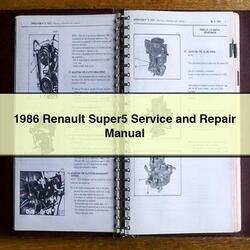
$16.99
This manual covers the Renault Super5, a B40 Series vehicle produced from 1984 to 1996. As a stylish and practical successor to the iconic Renault 5, the Super5 was designed to compete in the European supermini segment, targeting young drivers, small families, and urban commuters. Its modernized styling, improved aerodynamics, and enhanced interior space offered a compelling package of practicality and value. The Super5 was equipped with a range of front-mounted, transverse inline 4-cylinder engines, primarily from the Renault 'Cléon' family, with displacements including 950 cc, 1108 cc, and 1397 cc, often paired with carburetors. This manual provides comprehensive information for all Super5 models.
$16.99
The Renault R21 Nevada, produced in 1987, is a versatile station wagon known for its aerodynamic styling and spacious interior, designed as a practical family vehicle. Building upon the R21's front-wheel-drive platform, the Nevada variant offers enhanced cargo capacity, making it a capable option for everyday use and travel. This model was a significant part of Renault's mid-size offering during its production run, competing with other established European manufacturers.
$16.99
The Renault 5 Supercinq, produced between 1987 and 1991, is a notable European supermini celebrated for its practical design, economical operation, and urban maneuverability. As a significant evolution of the original R5, the Supercinq offered enhanced aerodynamics and interior comfort, solidifying its position as a popular choice in its segment. This generation, encompassing various engine options and trim levels, including performance variants, embodies Renault's expertise in creating accessible and user-friendly vehicles. Its compact dimensions and efficient packaging made it an ideal companion for city driving, while its straightforward engineering contributed to its reputation for reliability and ease of maintenance.
$16.99
The Renault Super5, a popular supermini produced from 1984 to 1996, represents a significant chapter in Renault's history of affordable and practical small cars. Introduced as a successor to the iconic Renault 5, the Super5 offered a blend of distinctive styling, efficient performance, and a surprisingly spacious interior for its compact dimensions. The 1990 model year signifies a mature iteration of this well-regarded platform, featuring refinements and various engine options, including the spirited GT Turbo variants. Known for its city-friendly size and solid engineering, the Super5 was a staple in the European market, competing effectively with other compact vehicles of its era.
$16.99
The Renault R19, a compact family car produced in 1991, was designed by the renowned Italian firm Giugiaro, emphasizing modern styling and aerodynamic efficiency. Available in various body styles including 3-door and 5-door hatchbacks, a 4-door saloon, and a 5-door estate, it offered a practical and comfortable interior for its class. Powered by transversely mounted inline 4-cylinder engines ranging from 1.4L to 1.8L, and typically featuring a 5-speed manual transmission, the R19 competed in the European market against models like the Volkswagen Golf and Ford Escort. While driver airbag availability was limited, it offered front disc and rear drum brakes, with ABS as an option on higher trims.
$16.99
The Renault R21 / Nevada, produced in 1991, represents a significant offering in the mid-size family car segment, known for its aerodynamic styling and spacious interiors. Available in various body styles including hatchback, saloon, and the practical Nevada estate (platform code L48 for hatchback, K48 for Nevada/Savanna), it competed with models like the Ford Sierra and Opel Vectra. This vehicle featured a range of transverse inline 4-cylinder engines, from 1.7L to 2.2L petrol and 2.1L diesel variants, with power outputs ranging from 70 hp to 175 hp for the R21 Turbo. Innovations included front-wheel drive, with optional all-wheel drive (Quadra) on select models, and a choice of manual or automatic transmissions.
$16.99
The Renault Super5, produced in 1994, is a practical and distinctive supermini known for its compact size, fuel efficiency, and surprisingly spacious interior. As an evolution of the original Renault 5, the Super5 benefited from aerodynamic refinements and updated mechanicals, making it a competitive offering in its segment against rivals like the Peugeot 205 and Ford Fiesta. This particular model year represents a late iteration, showcasing the culmination of the Super5's development.
$16.99
The Renault R19, produced in 1995, is a compact family car recognized for its modern European styling and practical design. Available in 3-door hatchback, 5-door hatchback, 4-door saloon (Chamade), and 5-door estate body styles, it offered a comfortable and well-packaged interior. The R19 was equipped with a range of efficient petrol and diesel engines, including 1.4L, 1.6L, 1.7L Diesel, 1.9L Diesel, and performance-oriented 1.8L 16v variants. Safety features evolved with the introduction of optional ABS and driver airbags on higher trims, reflecting the safety standards of its era. The R19 competed effectively in the C-segment against rivals like the Ford Escort and Volkswagen Golf, offering a reliable and practical choice for European families.
$16.99
This manual covers the Renault R21 Nevada, a versatile estate variant produced in 1995. The R21 model line, introduced in 1986, was known for its aerodynamic design, comfortable ride, and spacious interiors, competing effectively in the mid-size family car segment. The Nevada estate, in particular, offered significant practicality with a large cargo volume, making it suitable for families and those requiring extra carrying capacity. Available with a range of petrol and diesel engines, and offering front-wheel drive or optional four-wheel drive on performance variants, the R21 was engineered for a balance of efficiency and utility.
$16.99
The Renault R19, produced around 1998, represents a practical and comfortable compact family car, known for its distinctive styling, particularly in its coupé and cabriolet variants. Designed to compete in a highly contested segment, the R19 offered a refined driving experience and a practical interior, making it a strong contender in its market. Its engineering focused on aerodynamic efficiency, build quality, and safety, building upon Renault's legacy of producing accessible and reliable vehicles. This model, likely a Phase 2 facelift version, embodies a significant step in Renault's mainstream offerings, providing a blend of comfort and value.
$16.99
This workshop service repair manual covers the Mégane II, produced from 2002 to 2008, with model codes LM0/1_ and Z0_. This generation is known for its distinctive styling and advanced safety features, earning a 5-star Euro NCAP rating. The vehicle was available in various body styles, including 3-door and 5-door hatchbacks, a saloon, an estate (Tourer), and a Coupe-Cabriolet. It offered a range of petrol and diesel engines, such as the 1.4L 16V (K4J), 1.6L 16V (K4M), 2.0L 16V (F4R), 1.5L dCi (K9K), and 1.9L dCi (F9Q), paired with manual or automatic transmissions.

$16.99
This manual covers the S9U and S9W series diesel direct injection engines, specifically the 4-cylinder cast iron variants. These engines are integral to various Rxx models, including Rxx C, Rxx H, Rxx J, Rxx K, and Rxx 5, Rxx 7, as well as XD0 B, XD0 C, and XD0 F configurations. Engineered for robust performance, these engines are designed to meet the demands of their intended applications, emphasizing reliability and efficient operation.
$16.99
This comprehensive workshop service and repair manual covers the Renault K9K 1.5 dCi engine. It is designed to provide detailed instructions for all service and repair procedures, making it an invaluable resource for owners and technicians alike. The manual's step-by-step instructions, accompanied by pictures, simplify even complex maintenance tasks, empowering users to perform repairs efficiently and save on costs.
$16.99
This comprehensive service repair workshop manual provides detailed information for the Renault K9K 1.5 dCi engine. It is designed to cover all aspects of repair, servicing, and troubleshooting for this specific engine model. The manual is engineered to offer in-depth guidance, ensuring that users can effectively maintain and address issues with their vehicle's engine.

$16.99
This comprehensive service and repair manual covers the Renault K9K 1.5 dCi engine. Designed for ease of use, it provides in-depth information to assist owners and technicians in understanding and maintaining their vehicle. The manual details all aspects of servicing, repair, and routine maintenance, ensuring the longevity and optimal performance of the engine.
