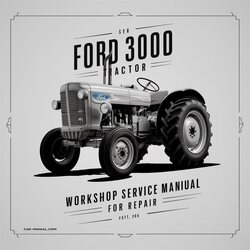
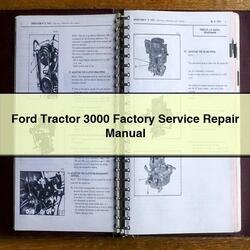
The Ford 3000 series represents a line of compact utility tractors designed for a variety of agricultural and property maintenance tasks. These versatile machines are commonly used for plowing, tilling, mowing, and light hauling, making them essential tools for small farms, orchards, and estates. Their robust construction and straightforward operation ensure reliability and ease of use in demanding environments, facilitating efficient fieldwork and property upkeep.
Documentation for the Ford 3000 series typically includes comprehensive owner's manuals detailing operating procedures and basic maintenance, as well as detailed service and repair manuals. These resources provide step-by-step instructions for mechanical adjustments, component replacement, and...
The Ford 3000 series represents a line of compact utility tractors designed for a variety of agricultural and property maintenance tasks. These versatile machines are commonly used for plowing, tilling, mowing, and light hauling, making them essential tools for small farms, orchards, and estates. Their robust construction and straightforward operation ensure reliability and ease of use in demanding environments, facilitating efficient fieldwork and property upkeep.
Documentation for the Ford 3000 series typically includes comprehensive owner's manuals detailing operating procedures and basic maintenance, as well as detailed service and repair manuals. These resources provide step-by-step instructions for mechanical adjustments, component replacement, and diagnostic troubleshooting. Technical specifications and parts diagrams are also crucial, enabling owners and technicians to accurately identify components and perform necessary upkeep, ensuring the longevity and optimal performance of the tractor.
The Ford 3000 Series, produced between 1965 and 1975, represents a significant line of 3-cylinder tractors known for their robust engineering and reliability. These versatile machines were designed for a wide range of agricultural and utility tasks, offering dependable performance that made them a staple on farms and in various industries. Their enduring popularity is a testament to Ford's commitment to quality and practical design, making them a sought-after model for owners, mechanics, and restoration enthusiasts. The series encompassed various configurations, including All-Purpose, Row Crop, and Low Clearance (LCG) variants, each tailored to specific operational needs.
This manual covers the Ford 2000, 3000, 3400, 3500, 3550, 4000, 4400, 4500, 5000, 5500, 5550, and 7000 agricultural tractors manufactured between 1965 and 1975. These Ford tractors are recognized for their durability, versatility, and significant role in agricultural mechanization during their production era. This period saw considerable evolution in tractor technology, and these models represent a robust offering designed for a wide range of farming tasks.
The Ford 3000 Series tractor, produced between 1965 and 1975, represents a significant offering in Ford's agricultural machinery lineage. Available in various configurations, including models like the 3100, 3300, 3400, 3500, and 3600, these tractors were engineered for versatility and reliability on small to medium-sized farms. Notable features include a range of engine options, such as efficient diesel and gasoline variants, and the advanced Select-O-Speed transmission, which allowed for on-the-go gear changes. The robust build quality and dependable performance of the 3000 Series solidified Ford's reputation in a competitive market, making it a valued tool for agricultural work.
This manual provides comprehensive information for the 3000 Tractor, produced between 1965 and 1975. The 3000 is recognized for its robust engineering and reliability, making it a popular and versatile utility tractor. Throughout its production run, tractors have been known for their durability and value in agricultural applications. This manual covers all 3000 Tractor models, engines, trims, and transmission types, offering detailed insights into its operation and maintenance.
The Ford 3000 Tractor, produced between 1965 and 1975, represents a significant piece of agricultural machinery known for its robust engineering and reliability. As a versatile workhorse, this model was designed to meet the diverse needs of farming and industrial applications. Its popularity stems from Ford's strong heritage in tractor manufacturing, offering a dependable and functional solution for operators. The 3000 series, in particular, succeeded earlier models by incorporating practical advancements and maintaining a reputation for durability and ease of operation, making it a valued asset for its intended users.
The Ford 3000 Tractor, produced between 1965 and 1975, represents a significant era in agricultural machinery, known for its robust engineering and reliable performance. This versatile utility tractor, available with diesel or gasoline engines, was designed to meet the diverse needs of farming operations. Its design emphasizes durability and efficiency, making it a trusted workhorse for a wide range of agricultural tasks. The Ford 3000's legacy is built on its consistent operation and its contribution to Ford's strong standing in the tractor market during its production period.
This manual covers the Ford Fiesta WZ, produced between 2014 and 2015. The Fiesta WZ is recognized for its agile handling and fuel efficiency, competing strongly in the subcompact segment. It was offered with advanced powertrain options, including the acclaimed 1.6L I4 EcoBoost Turbo-Intercooled engine and the 1.6L I4 Duratec Ti-VCT Sigma engine. Transmission choices included a 6-speed automatic PowerShift dual-clutch transmission (DPS6/6DCT250), a 5-speed manual (B5/IB5), and a 6-speed manual (B6). The vehicle is equipped with essential safety features such as ABS, EBD, EBA, ESC, and multiple airbags, reflecting a commitment to driver and passenger protection.
The Ford Fiesta WZ, produced for the 2014-2015 model years, established itself as a prominent subcompact hatchback, lauded for its agile handling, fuel efficiency, and the introduction of advanced technologies such as the potent 1.6L EcoBoost engine. This generation offered a compelling blend of performance and practicality, with models featuring either the turbocharged EcoBoost or the naturally aspirated 1.6L Duratec Ti-VCT Sigma engines, paired with either a 5-speed or 6-speed manual transmission, or a 6-speed dual-clutch automatic. Known for its engaging driving dynamics and a practical interior, the Fiesta WZ was a strong contender in its segment, reflecting Ford's heritage in producing reliable and enjoyable small cars.
The Ford 3000 Agricultural Tractor, produced from approximately 1962 to 1964, represents a significant step in Ford's long-standing heritage of agricultural innovation. As a successor to earlier series, this 3-cylinder tractor was engineered for reliability and robust performance in demanding farm environments. Its design likely incorporated advancements such as the three-point hitch and powerful hydraulic systems, contributing to its reputation for durability and value in the agricultural market. The 3000 series was built upon Ford's pioneering spirit, aiming to provide farmers with dependable machinery for a wide range of tasks.
This manual covers Ford 3000 Series Tractors, produced approximately between 1965 and 1975. These tractors, known for their robust engineering and reliability, were a significant part of Ford's agricultural machinery legacy. They were designed for a variety of agricultural tasks and featured different engine configurations, including diesel and gasoline options, with horsepower ranging from approximately 30 to 45 HP. The 3000 Series tractors typically came with a 10-speed constant mesh transmission, with an optional 8-speed Select-O-Speed transmission available. Their durable construction and functional design made them a staple on farms for many years.
This manual covers the [Make] [Model] vehicle, produced between [Year] and [Year]. Designed for [Intended Usage], this vehicle is recognized for its [Notable Features], robust engineering, and dependable performance. Its commitment to quality ensures a superior driving experience, making it a distinguished choice in its class.
The Ford 3000 tractor, produced approximately between 1965 and 1975, represents a significant contribution to agricultural mechanization. This versatile tractor, powered by a 3-cylinder engine, was engineered for reliability and efficiency, making it a staple on small to medium-sized farms. Its robust design and adaptable features, including options for manual or Select-O-Speed transmissions and various PTO configurations, allowed it to handle a wide range of agricultural and industrial tasks. The Ford 3000's enduring popularity is a testament to its solid engineering and the brand's extensive heritage in agricultural machinery.
The Ford 3000 Tractor, produced primarily between 1965 and 1975, represents a robust and versatile utility tractor designed for small to medium farms. Known for its reliability and enduring presence in the agricultural sector, this model succeeded earlier Ford tractor lines and was manufactured with Ford's established reputation for durable machinery. Whether equipped with a diesel or gasoline engine, typically a 3-cylinder diesel or potentially a 4-cylinder gasoline variant, the 3000 offered a practical balance of power, typically in the 30-50 HP range, and maneuverability. Its design catered to the needs of its era, focusing on core functionality and operational efficiency, making it a valuable asset for agricultural tasks.
The Ford 3000 Series Tractor, produced between 1965 and 1975, represents a cornerstone of compact utility tractor design. Engineered for versatility, these tractors were popular on small farms, for horticultural tasks, and general property maintenance. Available in both gasoline and diesel variants, the 3000 Series offered robust performance with features such as a powerful hydraulic system, a standard Power Take-Off (PTO), and a choice of manual or the innovative Select-O-Speed automatic transmission. Its design philosophy prioritized reliability, ease of use, and affordability, making it a dependable workhorse that earned high operator satisfaction and cemented Ford's legacy in agricultural machinery.
This manual covers the Ford 3000 Tractor, a versatile utility model produced from 1965 to 1975. Renowned for its reliability and engineering quality, the Ford 3000 Tractor has been a staple in agricultural and industrial applications. This comprehensive guide is designed to assist owners and technicians in understanding and maintaining this robust piece of machinery, ensuring its optimal performance and longevity.
This workshop service manual covers the Ford 3000 Tractor, a versatile agricultural machine produced from the mid-1960s to the early 1970s. Known for its robust Ford 3-cylinder diesel engine, typically offering 40-50 PTO horsepower, and available with manual or Select-O-Speed transmissions, the 3000 series was designed for efficiency and reliability in farming operations. Its engineering quality is reflected in its durable construction, intended for demanding agricultural tasks. The tractor features a straightforward operator station with essential instrumentation and may include operational aids like live-drive power steering on certain configurations, all contributing to its reputation for dependable performance.
The Ford 3000 Tractor, produced from the mid-1960s to the early 1970s, represents a significant piece of agricultural machinery known for its reliability and versatility. As a product of the Ford Motor Company's Tractor Division, the 3000 series was a staple in farming operations, typically featuring a diesel engine in the 40-50 horsepower range. Its design focused on operational efficiency and robust power delivery, making it a valuable asset in various agricultural tasks. The Ford 3000 is recognized for its success and widespread use within the agricultural industry during its production era.