The 1540 model represents a specific line of forage blowers designed for efficient crop material handling in agricultural operations. These machines are integral to harvesting and processing operations, particularly for ensilage and other feed preparation. Key characteristics include robust construction for demanding field conditions, variable discharge capabilities to suit different storage needs, and power take-off (PTO) or engine-driven options for operational flexibility. Their primary application is the rapid and uniform loading of forage into silos, wagons, or processing equipment, minimizing manual labor and maximizing throughput.
Documentation for the 1540 model typically includes comprehensive operator's manuals detailing safe operation, routine maintenance schedules,...
The 1540 model represents a specific line of forage blowers designed for efficient crop material handling in agricultural operations. These machines are integral to harvesting and processing operations, particularly for ensilage and other feed preparation. Key characteristics include robust construction for demanding field conditions, variable discharge capabilities to suit different storage needs, and power take-off (PTO) or engine-driven options for operational flexibility. Their primary application is the rapid and uniform loading of forage into silos, wagons, or processing equipment, minimizing manual labor and maximizing throughput.
Documentation for the 1540 model typically includes comprehensive operator's manuals detailing safe operation, routine maintenance schedules, and lubrication points. Technical service manuals provide in-depth repair procedures, exploded views of components, and diagnostic information for troubleshooting common issues. Parts catalogs are essential for identifying and ordering replacement components, ensuring the longevity and optimal performance of the equipment. These resources are critical for owners, farm managers, and service technicians to maintain the forage blower effectively and efficiently.
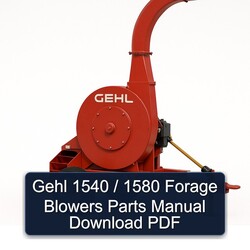
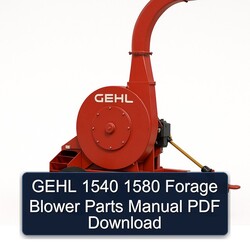
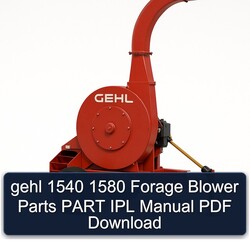
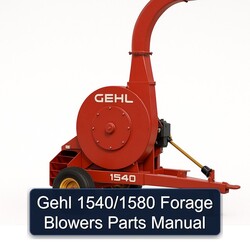
This manual pertains to the 1540 / 1580 Forage Blower. While specific production years are not detailed, this equipment is designed for agricultural applications, featuring robust engineering for reliable operation. The manual covers a comprehensive range of components, including the Spinner Bearings, Spinner Drive, Fan Assembly, Housing & Outlet, Frame & Wheels, Spinner Emergency Shutoff Control, Spinner Inlet, Hopper Inlet & Belt Cover, Hopper & Spinner Covers, and optional equipment.
This document pertains to the GEHL 1540/1580 Forage Blower, an attachment designed for efficient forage blowing operations. While specific production years are not detailed, the GEHL 1540/1580 represents a commitment to robust engineering and reliable performance in agricultural applications. Its primary function is to facilitate the movement of forage, making it a valuable tool for various farming tasks. The design emphasizes usability, catering to a wide range of users from first-time owners to professional technicians.
This manual pertains to the Gehl 1540 and 1580 Forage Blowers, essential agricultural machinery designed for efficient forage handling. These robust units are engineered for reliability and performance in demanding farm environments, featuring durable steel construction for components like the blower housing and impeller. Their PTO drive system, typically operating at 540 RPM, connects to standard tractor hitches, enabling versatile integration into existing farm operations. The design prioritizes effective material movement, though specific capacity and tractor power requirements vary based on operational conditions and crop type.
This manual covers the 1540/1580 Forage Blowers. These machines are engineered for reliable performance and efficiency in demanding agricultural applications. Key components include a robust blower assembly with fan and housing, a versatile drive system featuring telescoping drives for both 540 and 1000 RPM, and a sturdy frame with wheels. The hopper and covers are designed for ease of use and maintenance, while optional equipment such as a water injection system, tire guard, and various blower pipe configurations offer enhanced functionality.