



Bell 212

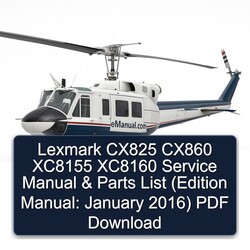
The Bell 212 is a versatile twin-engine helicopter widely utilized for a range of demanding missions. Originally developed as a commercial derivative of the UH-1 Iroquois, it is renowned for its robust construction, reliability, and adaptability. Common applications include troop transport, medical evacuation, search and rescue operations, offshore oil rig support, and general utility purposes. Its ability to operate in diverse environmental conditions and its capacity for carrying significant payloads make it a critical asset in both civilian and military aviation sectors.
Comprehensive documentation for the Bell 212 is essential for safe and efficient operation, maintenance, and repair. This includes detailed...
$16.99
This manual covers the Lexmark CX825, CX860, XC8155, and XC8160 series devices released in 2016. These devices are engineered for robust performance and reliability, offering advanced printing, scanning, and finishing capabilities suitable for demanding office environments. Their design emphasizes efficient operation and high-quality output, with features like versatile input/output configurations and optional finishers to meet diverse workflow needs.

$16.99
This Flight Manual pertains to the Bell 212, a versatile aircraft renowned for its robust twin-engine configuration and adaptability to various operational demands. Powered by two Pratt & Whitney Canada PT6T (Twin-Pac) turboshaft engines, each delivering approximately 1800 shp, the Bell 212 offers impressive performance with a maximum level flight airspeed of 241 km/h and a service ceiling of 3,810 meters at maximum gross weight. Its design features a two-bladed, fully articulated main rotor system and a two-bladed tail rotor, contributing to its stable flight characteristics. With a fuselage length of 12.37 meters and a main rotor diameter of 15.85 meters, this aircraft is engineered for reliability and efficiency, capable of carrying up to 14 passengers and a crew of 1-2.
