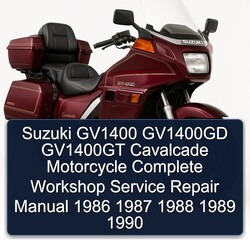
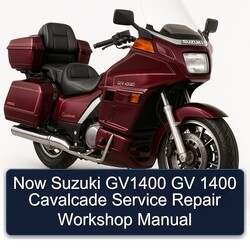
The GV1400 Cavalcade represents a specific model line of touring motorcycles designed for long-distance travel and comfort. These large-displacement bikes are characterized by their substantial fairings, integrated luggage systems, and powerful engines, all engineered to provide a smooth and protected riding experience. Their primary applications include cross-country journeys, commuting in various weather conditions, and providing a stable platform for carrying passengers and cargo, making them a popular choice for dedicated touring enthusiasts.
Documentation for the GV1400 Cavalcade typically includes comprehensive owner's manuals detailing operation and basic maintenance, as well as detailed service and repair manuals. These resources cover essential procedures such...
The GV1400 Cavalcade represents a specific model line of touring motorcycles designed for long-distance travel and comfort. These large-displacement bikes are characterized by their substantial fairings, integrated luggage systems, and powerful engines, all engineered to provide a smooth and protected riding experience. Their primary applications include cross-country journeys, commuting in various weather conditions, and providing a stable platform for carrying passengers and cargo, making them a popular choice for dedicated touring enthusiasts.
Documentation for the GV1400 Cavalcade typically includes comprehensive owner's manuals detailing operation and basic maintenance, as well as detailed service and repair manuals. These resources cover essential procedures such as routine servicing, engine overhauls, electrical system diagnostics, and component replacement. Technical specifications, parts diagrams, and troubleshooting guides are also vital, empowering owners and certified technicians to maintain the motorcycle's performance, ensure safety, and address any potential issues effectively.
This manual covers the [Make] [Model] vehicle, produced from [Year] to [Year]. Engineered for [Intended Usage], this vehicle is recognized for its [Notable Feature 1] and [Notable Feature 2]. Its design prioritizes [Engineering Quality Aspect] and long-term reliability, making it a distinguished choice for discerning owners.
This workshop service repair manual provides comprehensive information for the Suzuki GS850G, covering production years from 1979 to 1988. The GS850G is part of Suzuki's esteemed GS series, recognized for its smooth inline-three engine and reliable shaft drive, making it a capable mid-size touring and general-purpose motorcycle. Throughout its production, the GS850G was lauded for its refined performance and touring comfort, reflecting Suzuki's commitment to engineering quality and rider satisfaction.
This manual covers the GSX400 FW and FWS models produced between 1983 and 1985. These motorcycles represent a significant point in sportbike lineage, offering a blend of performance and handling characteristic of the era. The FW designation typically denotes a full fairing, while the FWS variant signifies a full fairing sport model, both built upon a robust inline-four cylinder, air-cooled engine. Engineered for spirited riding, these models were recognized for their accessible performance and commitment to quality.
The Suzuki GSX750-ES, produced from 1984 to 1986, was a prominent sportbike that embodied the rapid technological advancements of its era. Powered by a 748cc, DOHC, 16-valve, air-cooled inline-four engine, this model offered a compelling blend of performance and handling, competing effectively in the evolving sportbike market. Notable technical features included the Twin Swirl Combustion System (TSCC) for enhanced efficiency and advanced suspension and braking systems for its time, including dual front disc brakes and a single rear disc brake. Its design and engineering reflected a heritage of producing performance-oriented motorcycles.
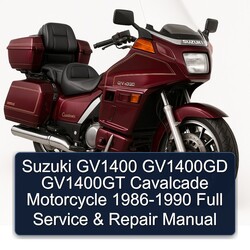
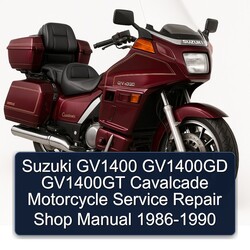
The Suzuki GV1400 Cavalcade, produced between 1986 and 1990, represents Suzuki's entry into the full-dress touring motorcycle market. Available in models GV1400GD and GV1400GT, this first-generation flagship tourer was engineered for comfortable long-distance travel, featuring a powerful liquid-cooled, 1360 cc V-twin engine, shaft drive, and comprehensive fairings for rider protection. Its design philosophy prioritized comfort and capability, aiming to compete with established touring motorcycles of the era through robust engineering and a focus on rider amenities.
The Suzuki GV1400 Cavalcade, produced from 1986 to 1990, was a significant entry into the luxury touring motorcycle market. Distinguished by its powerful 1360cc V-twin engine and shaft drive, it offered a comfortable and capable platform for long-distance journeys, competing with established models from other manufacturers. Key features included substantial fairings for weather protection, integrated luggage, and comfortable seating for both rider and passenger, often enhanced with amenities like audio systems and cruise control on select variants (GV1400GD, GV1400GT). The Cavalcade represented Suzuki's commitment to delivering a premium touring experience, blending performance with rider comfort and the inherent low-maintenance benefits of shaft drive.
Welcome to the comprehensive service and repair manual for the GV1400 Cavalcade, produced between 1986 and 1990. This motorcycle, available in variants such as the GV1400GD and GV1400GT, was engineered as a formidable contender in the full-dress touring segment, featuring a powerful liquid-cooled V-4 engine with a displacement of 1360 cc. The legacy of reliable engineering is evident in the Cavalcade's robust frame, advanced (for its time) features like electronic cruise control, and its comfortable design intended for long-distance journeys. The model's emphasis on stability and rider comfort, coupled with its shaft drive and hydraulically operated wet multi-plate clutch, positioned it as a significant offering in its class.
The 1986-1990 Suzuki GV1400 Cavalcade represents Suzuki's commitment to the full-dress touring motorcycle segment, offering a comfortable and capable experience for long-distance journeys. This model, often referred to simply as the Cavalcade, is powered by a robust liquid-cooled, 4-stroke, V-twin engine displacing 1360 cc, designed for smooth power delivery and reliable performance. Known for its touring amenities, the GV1400 Cavalcade was engineered to provide riders with a premium experience, featuring a substantial frame, comfortable seating, and ample storage, making it a notable entry in the luxury touring market of its era.
The Suzuki GS500 and GS500E, produced from 1989 through 1999, represent a legacy of reliable and accessible motorcycling. These parallel-twin, air-cooled machines are celebrated for their straightforward engineering, making them an excellent choice for both new riders and experienced enthusiasts seeking a dependable, versatile motorcycle for commuting, touring, and general sport riding. Their design philosophy emphasizes user-friendliness and durability, contributing to a high reputation for owner satisfaction and a benchmark status within the entry-level to mid-range motorcycle segment.
This workshop service repair manual provides comprehensive information for the Suzuki GSX1100FL Katana, produced in 1990. The GSX series represented Suzuki's commitment to high-performance sportbikes, with the Katana line distinguished by its unique aerodynamic styling and potent engines. The GSX1100FL, part of the second generation of the Katana series, builds upon the legacy of its predecessors, offering a blend of power and distinctive design. This manual is designed to assist owners and technicians in maintaining and repairing this iconic motorcycle, ensuring its optimal performance and longevity.
This manual provides comprehensive technical information for the 1990 Suzuki GSX600FL Katana. As a refined iteration of the iconic Katana lineage, this sportbike is powered by a robust inline-four cylinder, DOHC, 4-stroke engine with a displacement of 599 cc, featuring Mikuni VM22SS carburetors and an electronic ignition system. Its engineering quality is evident in its reliable performance and distinctive aerodynamic styling, which made the Katana line a significant contributor to Suzuki's reputation in the sportbike market. This model is equipped with a 6-speed constant mesh transmission, wet multi-plate clutch, and a Suzuki Full Floater rear suspension system, complemented by hydraulic disc brakes front and rear for effective stopping power.
The 1991 Suzuki GSX-R750, chassis code GR75A, is a testament to Suzuki's heritage in performance motorcycles. This inline-4, four-stroke machine, powered by a 749 cc engine, was engineered for enthusiasts seeking a blend of track-bred capabilities and street-legal performance. Its design, representing an evolution in the acclaimed GSX-R lineage, focused on advanced chassis dynamics, aerodynamic efficiency, and a potent power delivery, solidifying its reputation as a true superbike of its era.
This manual covers the 1992 Suzuki GSX750FN Katana, a motorcycle renowned for its distinctive styling and performance. As part of the iconic Katana lineage, which dates back to the early 1980s and is known for aviation-inspired design, this model represents a specific iteration from the third generation of Katanas. Suzuki has a long-standing reputation for engineering excellence and reliability in motorcycle production. The GSX750FN features an inline 4-cylinder, 4-stroke engine with DOHC and air/oil cooling, paired with a 6-speed sequential transmission and a wet, multi-plate clutch. Its chassis includes dual front disc brakes and a single rear disc brake for effective stopping power.
This manual covers the sportbike motorcycle, encompassing a wide range of model designations from 1993 through 2010, with supplements available for specific years between 1988 and 2009. The GSX-R750 has a distinguished history as a premier supersport motorcycle, celebrated for its potent inline-4 engine, advanced chassis dynamics, and track-day prowess. Throughout its evolution during this period, it transitioned from oil-cooled to liquid-cooled engines, adopted electronic fuel injection, and featured significant chassis and suspension advancements, solidifying its reputation as a benchmark in its class.
This manual covers the 1994 Suzuki GSX1100FR Katana, a performance motorcycle renowned for its distinctive styling and powerful inline-four engine. Building on Suzuki's heritage of producing high-performance machines, the GSX1100FR represents a significant iteration of the iconic Katana lineage, blending potent engineering with a unique aesthetic. Its design philosophy prioritizes a combination of strong engine performance and striking visual appeal, making it a notable entry in the sportbike and naked sportbike segments of its era.
The Suzuki GSX-R1100, produced from 1993 to 1995, stands as a prominent hyperbike in the sportbike category, renowned for its high horsepower and torque, delivering exhilarating performance. As part of the esteemed GSX-R lineage, these models are recognized for their racetrack-derived technology, featuring a liquid-cooled, 4-stroke, DOHC, 16-valve, inline-four engine with a displacement of 1075 cc. Its engineering quality is evident in its aluminum twin-spar frame and advanced suspension systems, positioning it as a direct competitor to other leading sportbikes of its era. This generation of the GSX-R1100 represents a significant evolution, offering enthusiasts and performance riders a machine built for speed and handling.
This workshop service repair manual provides comprehensive guidance for the 1996 Suzuki GSX750FT Katana sportbike motorcycle. Known for its distinctive styling and performance, the Katana line has a rich heritage in the motorcycle industry. This particular model, the GSX750FT, represents a refinement of the iconic Katana concept, incorporating engineering advancements of its era. With its inline-4 cylinder, 4-stroke, DOHC, air/oil-cooled engine, the GSX750FT was designed for riders seeking a blend of performance and distinctive aesthetics.
The Suzuki GSXR1300 Hayabusa, first generation, represents a pinnacle of sportbike engineering, renowned for its extreme speed, aerodynamic design, and powerful performance. Introduced in 1999, this hyperbike redefined the category, pushing the boundaries of motorcycle capabilities and establishing new benchmarks for acceleration and top speed. Its sleek, wind-tunnel-developed bodywork is optimized for reduced drag, complementing the long-stroke inline-four engine, which delivers substantial torque and high-end horsepower. Built with a heritage of quality, the Hayabusa is engineered for riders seeking unparalleled performance and a truly exhilarating experience.
This manual covers the GSX-R1000, a renowned supersport motorcycle produced across its first three generations from 2001 to 2010. Celebrated for its performance-oriented design, this model features a high-revving inline-four engine, advanced chassis dynamics, and an aerodynamic profile, making it a formidable machine for both street and track use. The legacy in performance motorcycle development is evident in the GSX-R1000's consistent acclaim from industry publications, solidifying its reputation as a leader in its segment.
The 2004 Suzuki DL650 V-Strom is a versatile sport touring and adventure touring motorcycle, distinguished by its 645 cc V-twin engine featuring a 90-degree V configuration and electronic fuel injection. Engineered with an aluminum twin-spar frame, telescopic front forks, and a link-type rear shock, it offers a balanced and comfortable ride suitable for commuting, long-distance touring, and light off-road excursions. Its design philosophy emphasizes reliability and adaptability, making it a capable and enduring machine in its class.
This manual covers the [Vehicle Make] [Vehicle Model], produced from [Start Year] to [End Year]. This vehicle is renowned for its [Notable Feature 1] and [Notable Feature 2], making it an excellent choice for [Intended Usage]. Its design emphasizes [Engineering Quality] and [Reliability], offering a unique blend of performance and practicality for discerning drivers.
This manual covers the GSX1300BK B-King, a performance naked sportbike produced for the 2007, 2008, and 2009 model years. The GSX1300BK is distinguished by its aggressive styling, a powerful 1298cc inline-four engine derived from the Hayabusa, and a distinctive dual exhaust system. Its engineering emphasizes a comfortable yet sporty riding position, making it a unique offering in its class. The heritage in high-performance motorcycles, particularly its Hayabusa engine technology, forms the foundation of this model's exceptional capabilities.
The 2009 Suzuki GSX-R1000 is a celebrated superbike renowned for its exceptional performance, precise handling, and track-day capabilities. This model, part of Suzuki's esteemed GSX-R lineage, features a potent 999cc liquid-cooled inline-four engine, a lightweight aluminum twin-spar frame, and advanced electronic fuel injection with the Suzuki Dual Throttle Valve (SDTV) system. Its design prioritizes rider feedback and control, making it a formidable machine for both spirited road riding and competitive track use.
This manual covers the GSXR series from 1985 to 1992 and the Katana series from 1988 to 1996, encompassing all engine sizes within these ranges. These iconic motorcycles, known for their sportbike heritage and distinctive styling, represent significant engineering achievements. The GSXR line revolutionized sportbike performance with its lightweight construction and powerful engines, while the Katana offered a blend of sport and sport-touring capabilities. Both models from this era are celebrated for their robust performance and are a testament to the legacy in motorcycle manufacturing.
The Suzuki DL650 V-Strom, specifically the K4 model, is an adventure sport touring motorcycle renowned for its versatility, reliability, and robust engineering. Launched in 2004, this iteration of the V-Strom established a strong reputation in its segment, offering a capable platform for both long-distance touring and general riding. Its 645 cc V-twin engine, featuring a liquid-cooled, DOHC, 8-valve configuration, delivers approximately 67 horsepower and 60 Nm of torque, providing a balanced performance suitable for a wide range of conditions. The motorcycle's design prioritizes rider comfort and practicality, making it a popular choice for riders seeking a dependable and adaptable machine.
The Suzuki GS500, available in both the fully faired GS500F and the naked GS500 variants, represents a lineage of reliable and accessible motorcycles produced by Suzuki Motor Corporation from 1988 to 2009. Powered by a robust 4-stroke, air-cooled, parallel-twin engine with a displacement of 487 cc, the GS500 is celebrated for its engineering quality and straightforward design, making it an excellent choice for both new riders and experienced enthusiasts seeking economical and dependable transportation. Its steel diamond frame, coupled with hydraulic disc brakes, ensures stable handling and effective stopping power, contributing to its reputation as a user-friendly and enduring model in the motorcycle market.
The Suzuki Hayabusa, also known by its model designation GSX-R1300R and nicknames like "The Bus" or "The Falcon," is a legendary sportbike produced from 1999 to 2006. Renowned for its revolutionary aerodynamic efficiency, extreme performance, and long-distance comfort, it was engineered to be the fastest production motorcycle in the world. This first-generation Hayabusa set a new benchmark in the hyperbike category, offering a potent 1299 cc inline-4 engine delivering approximately 175 horsepower, designed for unparalleled speed and stability. Its robust twin-spar frame and advanced fairing contribute to its exceptional handling and rider protection, making it a dominant force against contemporaries like the Kawasaki Ninja ZX-12R and Ducati superbikes of its era.
The Suzuki GV1400 Cavalcade, produced from 1986 to 1990, is a full-size, Japanese touring motorcycle designed for long-distance travel and comfortable cruising. This V-twin, 4-stroke, liquid-cooled machine, with a displacement of 1360 cc, emphasizes a stable and powerful ride, offering ample comfort for both rider and passenger. Its distinct styling, comfortable seating, and generous storage capacity were key selling points, positioning it as a strong competitor in the large-displacement touring segment against models like the Honda Gold Wing and Yamaha Venture Royal Star.