The F Models category encompasses a specific range of Kawasaki motorbikes designed for various riding experiences. These models are known for their performance-oriented engineering and are often utilized for sport riding, track days, and spirited street use. Key characteristics include advanced suspension systems, powerful engines, and aerodynamic designs, reflecting their focus on dynamic capability and rider engagement. This collection represents a significant segment within Kawasaki's motorcycle offerings, catering to enthusiasts who prioritize agility and responsive handling.
Documentation for the F Models typically includes comprehensive service manuals detailing routine maintenance schedules, diagnostic procedures, and repair instructions for all major components. Technical specification...
The F Models category encompasses a specific range of Kawasaki motorbikes designed for various riding experiences. These models are known for their performance-oriented engineering and are often utilized for sport riding, track days, and spirited street use. Key characteristics include advanced suspension systems, powerful engines, and aerodynamic designs, reflecting their focus on dynamic capability and rider engagement. This collection represents a significant segment within Kawasaki's motorcycle offerings, catering to enthusiasts who prioritize agility and responsive handling.
Documentation for the F Models typically includes comprehensive service manuals detailing routine maintenance schedules, diagnostic procedures, and repair instructions for all major components. Technical specification sheets provide essential data on engine performance, dimensions, and electrical systems. Furthermore, troubleshooting guides and parts catalogs are readily available to assist owners and certified technicians in identifying and resolving issues, ensuring optimal performance and longevity of these specialized motorcycles.
This manual covers the Kawasaki KZ400, KZ500, and KZ550 motorcycle models produced for the 1979, 1980, and 1981 model years. These motorcycles, powered by air-cooled four-stroke engines ranging from approximately 399cc to 553cc, were recognized for their performance and value in the middleweight segment. Featuring reliable parallel-twin or inline-four configurations, 5-speed transmissions, and effective braking systems including hydraulic disc brakes, these models offered a blend of sport and standard riding characteristics. Kawasaki, a manufacturer with a strong heritage in performance motorcycles, engineered these bikes to provide a robust and engaging riding experience.
This manual provides comprehensive service and repair information for a range of motorcycles, including the GPZ 400, GPZ 550, Z 400 F, Z 400 FII, Z 500, and Z 550 F models produced between 1983 and 1985. These motorcycles represent a significant period in history, known for their inline-four engines, advanced (for the time) chassis designs like the Uni-Trak rear suspension, and performance-oriented capabilities. The GPz series, in particular, helped define the sportbike category, offering a blend of speed, handling, and distinctive styling that garnered positive reception and contributed to the reputation for engineering excellence.
This manual covers the GPZ400, GPZ550, Z400, Z500, Z550, Z400F, and Z550F models produced between 1983 and 1985. These motorcycles represent a significant era in sportbike and performance motorcycle development, building upon the robust engineering of the Z series and introducing the more aerodynamic and performance-focused GPZ line. Known for their parallel-twin engines, offering displacements from approximately 400cc to 554cc, and featuring advanced (for the time) DOHC configurations, these bikes provided a balance of performance and reliability. Their design often included front disc brakes and 6-speed transmissions, contributing to their reputation as capable machines for both spirited riding and everyday use.
This manual covers the GPZ400, GPZ550, Z400F, Z500F, and Z550F models produced between 1983 and 1985. These motorcycles represent engineering prowess from the mid-1980s, known for their sport-oriented designs, advanced suspension systems like Uni-Trak, and robust parallel-twin engines. The GPZ series, in particular, was recognized for its performance and aerodynamic styling, while the Z models offered a strong foundation in motorcycle lineage. This comprehensive guide is designed for both DIY enthusiasts and professional mechanics seeking to maintain and repair these iconic machines.
This workshop service repair manual provides comprehensive guidance for the Kawasaki Z 400 F motorcycle, produced between 1983 and 1985. Known for its approachable performance and handling, the Z 400 F was a popular choice for riders seeking a capable and stylish naked bike, fitting into the compact/mid-size naked motorcycle segment. Building on Kawasaki's legacy of performance-oriented machines, this model offered a balance of usability and engaging riding dynamics, likely competing with similar offerings from Yamaha, Suzuki, and Honda of the era.
This document provides comprehensive service information for the Kawasaki Z 400 F, covering models from 1983, 1984, and 1985. Kawasaki has a long-standing reputation for engineering quality and reliability, and the Z series represents a lineage of performance motorcycles known for their sportbike capabilities. The Z 400 F, with its air-cooled inline twin-cylinder engine and 6-speed manual transmission, embodies the performance and spirit characteristic of Kawasaki's mid-1980s offerings, designed for informed ownership and expert maintenance.
This workshop service repair manual covers the motorcycle, produced between 1983 and 1985. Known for its inline-four engine and reliable performance, the Z 500 F represents a significant model in heritage of sport-standard motorcycles. This manual provides comprehensive information essential for the upkeep and repair of this classic machine, reflecting a commitment to engineering excellence.
The Kawasaki Z500 F, produced from 1983 to 1985, is a significant motorcycle in the mid-size sportbike segment. Known for its strong performance for its class, reliable Kawasaki engineering, and distinctive Z styling, this first-generation model offered a compelling package. It competed effectively with other Japanese and European manufacturers, appealing to riders seeking a blend of speed and agility. The Z500 F represents a key step in Kawasaki's lineage of sport motorcycles, building on the heritage of its predecessors and influencing future designs.
This manual covers the Z 550 F, produced from 1983 to 1985. The Z 550 F is a mid-size naked sportbike, recognized for its balanced performance and reliability, fitting into the esteemed Z series lineage. It offers a versatile and user-friendly experience, blending sporty capabilities with everyday practicality, a hallmark of design philosophy during that era. This model features an air-cooled, inline-four DOHC engine with a displacement of 553 cc, paired with a 6-speed manual transmission and a wet, multi-plate clutch. Its robust engineering and accessible performance made it a competitive option in its segment.
This manual covers the Kawasaki GPZ900R, a groundbreaking sport-touring motorcycle produced from 1984 to 1990, encompassing chassis codes ZX900-A1 through ZX900-A7. Renowned as a revolutionary machine for its era, the GPZ900R pioneered the use of a full fairing designed in a wind tunnel and featured advanced engineering such as its liquid-cooled, 16-valve inline-four engine and, on early models, an anti-dive front suspension system. Its innovative chassis design provided a balanced blend of sport and touring capabilities, solidifying Kawasaki's legacy of building powerful and technologically advanced motorcycles and setting a new standard in the superbike category.
This manual pertains to the Kawasaki ZXR750 ZXR 750 motorcycle, specifically models produced in 1990. The ZXR750 is recognized for its performance-oriented design, catering to riders seeking a dynamic and capable machine. Its engineering emphasizes a balance of power and handling, making it a notable entry in its class. This guide is intended to support owners and technicians in understanding and maintaining this specific model.
This manual covers the Kawasaki ZZ-R250, a compact and agile sportbike produced for the first generation from 1990 to 1996. Designed as an accessible entry-level to mid-range sportbike, it offers a balance of fuel efficiency and sporty ergonomics, characteristic of Kawasaki styling from the era. With its liquid-cooled, parallel-twin engine, the ZZ-R250 provides approachable performance for new riders, commuters, and budget-conscious enthusiasts. Its engineering prioritizes reliability and ease of maintenance, making it a practical choice for daily use and spirited riding.
This manual covers the Kawasaki ZX600 sportbike, produced from 1990 through 2000. Known for its inline 4-cylinder, liquid-cooled engine and robust engineering, the ZX600 has been a significant model in Kawasaki's sportbike lineage. This generation of the ZX600 series is recognized for its performance and handling capabilities, making it a popular choice for riders seeking a capable sportbike experience. The manual provides comprehensive information for all styles of this model, reflecting Kawasaki's reputation for building high-performance motorcycles.
The Kawasaki Ninja ZX-6R, produced from 2000 to 2002, is a performance-oriented supersport motorcycle known for its sharp handling, potent inline-four engine, and aerodynamic styling. This generation, often designated ZX600J, features a 599cc engine delivering approximately 118-125 horsepower, coupled with a 6-speed transmission and a responsive chassis. Its engineering quality is evident in its aluminum alloy twin-spar frame and fully adjustable suspension, making it a capable machine for both track days and spirited street riding, competing directly with other prominent models in the 600cc supersport segment.
This manual covers the Kawasaki Ninja ZX6R models produced between 2000 and 2002, specifically the ZX600J, ZX600K, and ZX600P variants. Known for its high-revving inline-four engine and track-day capability, the Ninja ZX6R has been a significant contender in the supersport motorcycle class. Its design emphasizes sporty handling and performance, building on Kawasaki's legacy of engineering excellence and innovation in motorcycle manufacturing. This generation of the ZX6R features sharp bodywork and internal engine updates aimed at enhancing its already potent performance, making it a popular choice for riders seeking a thrilling and capable machine.
The Ninja ZX-6R, model code ZX600 and part of the J-Model generation (ZX600J/J1/J2), is a high-performance supersport motorcycle produced for the 2000, 2001, and 2002 model years. Renowned for its sharp handling, aggressive supersport styling, and a high-revving 599cc inline-four cylinder engine, the ZX-6R was engineered for performance-oriented riders and track day enthusiasts. Its aluminum perimeter frame and advanced suspension systems contribute to its agile dynamics, making it a formidable competitor in its class.
The Kawasaki ZX12R, produced from 2000 to 2006, represents a pinnacle of hypersport motorcycle engineering, designed for ultimate speed, power, and aerodynamic efficiency. This model, a direct competitor to other high-performance sportbikes of its era, embodies Kawasaki's legacy of innovation and performance. Its advanced engine technology and chassis design deliver exhilarating acceleration and handling, making it a sought-after machine for enthusiast riders. The ZX12R is characterized by its liquid-cooled, 16-valve inline-four engine, sophisticated fuel injection, and robust construction, all contributing to its reputation for raw performance and cutting-edge engineering.
The 2005 Kawasaki Ninja ZX6RR is a high-performance sport motorcycle designed for enthusiasts and racers seeking track-oriented capabilities. As a homologation special variant of the ZX-6R, it features a 599 cc inline-four engine with a racing kit specification, delivering exceptional power and responsiveness. Its advanced chassis dynamics, including an aluminum perimeter frame and fully adjustable suspension, contribute to superior handling and stability. Built with Kawasaki's legacy of engineering excellence, the ZX6RR offers a blend of cutting-edge technology and robust construction, making it a formidable competitor in the supersport segment.
The BMW F650GS Dakar, model code R13, produced from 2005 to 2007, is a mid-size adventure touring motorcycle renowned for its versatility and go-anywhere capability. This model is distinguished by its extended suspension travel, larger front wheel, increased ground clearance, and a higher screen, all contributing to its robust off-road prowess and long-distance touring comfort. Drawing on a heritage in motorcycle manufacturing, the F650GS Dakar is designed for riders who seek adventure across diverse terrains, bridging the gap between on-road performance and off-road exploration, making it a capable companion for both daily commutes and extensive journeys.
The F650GS R13, produced between 2005 and 2007, represents a capable and versatile adventure touring motorcycle. Known for its robust single-cylinder engine, comfortable ergonomics, and dual-purpose design, it effectively bridges the gap between lighter dual-sport machines and larger touring bikes. This model competed in a segment valuing reliability, refined engineering, and user-friendliness, offering a premium European alternative. Key features include its 652cc liquid-cooled engine, available ABS, and a steel-trellis frame, making it well-suited for both paved roads and light off-road excursions, a testament to enduring legacy in motorcycle manufacturing.
This manual covers the BMW F800S (K71) motorcycle, produced for the model years 2006 through 2009. As a versatile sport touring motorcycle, the F800S is powered by a 798 cc parallel-twin engine, delivering 85 horsepower and 57.5 lb-ft of torque. Known for BMW's engineering excellence, this model offers a blend of performance and comfort, making it suitable for both spirited riding and longer journeys. Key features include a multi-plate wet clutch, a 6-speed sequential gearbox, and a chain final drive, complemented by dual front disc brakes and a single rear disc brake, with optional Integral ABS.
The BMW F800ST (K71), produced from 2006 to 2009, represents BMW Motorrad's commitment to engineering excellence and sport-touring capability. This parallel-twin motorcycle, powered by a 798 cc liquid-cooled engine, offers a balanced blend of performance and comfort, making it suitable for both daily commuting and extended journeys. Known for its reliability and accessible design within the F-series range, the F800ST features a 6-speed gearbox, a multi-disc wet clutch, and a distinctive toothed belt final drive. Optional ABS further enhances its safety features, complementing its halogen headlight and LED taillight.
The F650GS (K72) is a versatile adventure touring motorcycle produced from 2008 to 2011, designed for both on-road commuting and light off-road excursions. Built upon a legacy of engineering excellence and reliability, this model features a robust 800 cc parallel-twin engine, shared with other F800 series bikes, offering a balanced blend of performance and refinement. Its design prioritizes rider comfort and practicality, making it a capable machine for a wide range of riding conditions and a popular choice for owners seeking dependable adventure.
The BMW F800GS (K72) is an adventure touring motorcycle produced from 2008 to 2013, designed to excel in both on-road touring and off-road exploration. It features a liquid-cooled, parallel-twin engine with a displacement of 798 cc, delivering approximately 85 horsepower and 83 Nm of torque. Its engineering emphasizes a balance of BMW's renowned touring comfort and robust capability, highlighted by its long-travel suspension, dual disc front brakes, and optional ABS. This versatile machine was positioned as a mid-weight adventure option, appealing to riders seeking a capable and reliable partner for diverse riding conditions.
The BMW F800R (K73) motorcycle, produced between 2009 and 2013, embodies BMW's commitment to engineering excellence and rider engagement. This naked sportbike, or roadster, is characterized by its minimalist design, ergonomic rider focus, and agile handling. Powered by a 798 cc parallel-twin engine, it delivers a broad torque band and smooth power delivery, offering approximately 85-90 horsepower. Its sporty chassis, featuring a parallel-twin engine known for its broad torque band and smooth power delivery, makes it a versatile machine for both spirited riding and everyday use. The F800R competes in a segment with other renowned naked motorcycles, highlighting its position as a capable and stylish option.
The BMW F700GS, model code K70, is a versatile adventure touring motorcycle produced in 2013. Known for its reliable parallel-twin, liquid-cooled engine with a displacement of 798 cc, it offers approximately 75 horsepower and 61 lb-ft of torque, making it suitable for both touring and light off-road exploration. Key features include comfortable ergonomics, an accessible seat height of approximately 820 mm, a 16-liter fuel tank, and standard BMW Motorrad ABS. This model represents a balance of performance, comfort, and value within the middleweight adventure-sport segment, building upon BMW's extensive heritage in motorcycle manufacturing.
The BMW F800GT (K71) is a 2013 sport touring motorcycle renowned for its blend of performance, comfort, and versatility. Powered by a liquid-cooled, four-stroke, parallel-twin engine with 798 cc displacement, it delivers approximately 90 hp and 86 Nm of torque, offering accessible power delivery ideal for both long-distance touring and spirited riding. Its design emphasizes comfortable ergonomics for extended journeys, complemented by features such as an optional ABS system and the potential for ASC and ESA on select models. Building on BMW Motorrad's heritage of engineering excellence, the F800GT is engineered for reliability and offers a refined riding experience.
This manual covers the 2013 BMW F800GS Adventure, a versatile parallel-twin adventure touring motorcycle renowned for its robust engineering and capability across diverse terrains. Designed for riders seeking a blend of on-road comfort and off-road prowess, the F800GS Adventure features a 798 cc engine producing 85 hp and 62 lb-ft of torque, a substantial 24-liter fuel tank for extended range, and suspension optimized for demanding conditions. Its parallel-twin configuration, coupled with BMW's commitment to quality, makes it a reliable choice for long-distance travel and exploration.
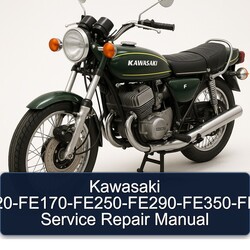
This manual covers the Kawasaki FE120, FE170, FE250, FE290, FE350, and FE400 series engines. These engines are designed for a variety of applications, emphasizing robust construction and dependable performance. Their engineering reflects Kawasaki's commitment to quality and durability, making them suitable for demanding operational environments.
This manual covers the KAWASAKI KAF300 MULE 500 UTILITY VEHICLE, a robust utility vehicle designed for demanding tasks. Engineered for reliability and performance, this model is built to assist with a wide range of professional and personal applications. Its construction emphasizes durability and efficiency, making it a dependable choice for various operational needs.
This manual covers the Kawasaki KAF450 Mule 1000, a versatile utility vehicle designed for a range of tasks. Engineered for reliability and performance, the Mule 1000 offers robust construction and practical features suitable for work and recreational use. Its design prioritizes durability and ease of operation, making it a dependable choice for various applications.
This service repair manual covers the Kawasaki STX 15 F personal watercraft. Engineered for performance and reliability, this watercraft is designed for various water activities. Its robust construction and advanced internal combustion engine, utilizing gasoline fuel and a jet propulsion system, ensure a superior operational experience. This manual provides comprehensive information to understand and maintain the watercraft's complex systems, including its cooling, fuel, lubrication, electrical, propulsion, steering, suspension, and hull components.
This manual covers the Z750 motorcycle, model code ZR750-J1. Known for its versatility as a mid-weight naked sportbike, the Z750 offers a compelling blend of performance and everyday usability. Its engineering is characterized by an inline 4-cylinder, DOHC, 16-valve engine with approximately 750cc displacement, a liquid-cooled system, and a 6-speed transmission. The model line has a history of providing a balanced riding experience, making it suitable for a wide range of enthusiasts.
German-language service repair manual for the Kawasaki ZRX1200R and ZRX1200S retro sport motorcycle. Covers 1164cc inline-four engine overhaul, valve clearance adjustment, four Keihin carburetor synchronization, clutch service, Kayaba inverted fork rebuild, Uni-Trak monoshock overhaul, brake system maintenance, chain and sprocket replacement, cooling system service, electrical diagnostics including CDI and regulated-rectifier testing, steering head bearing replacement, and all maintenance procedures with OEM torque specifications and exploded parts diagrams.
This manual covers the Kawasaki F5, F6, F7, F8, and F81M models, which are rotary disc valve two-stroke trail bikes produced from the late 1960s through the mid-1970s. These lightweight, off-road oriented motorcycles were known for their reliable and simple two-stroke engines, often featuring air-cooling and rotary disc valve induction for improved performance. They competed effectively in the trail riding segment against contemporaries from Yamaha, Honda, and Suzuki. The F-series models, including the F5 'Bighorn' and F7 (175cc), offered agile handling and capable performance for their time, making them popular among enthusiasts and collectors.
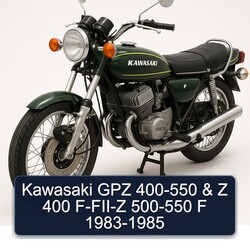
This manual covers the Kawasaki GPZ 400, GPZ 550, Z 400 F, Z 400 F-II, Z 500 F, and Z 550 F motorcycles produced between 1983 and 1985. These inline-four, four-stroke motorcycles, featuring DOHC valve trains, were known for their sporty performance and aerodynamic designs, with displacements ranging from approximately 399cc to 550cc. The GPZ models were liquid-cooled, while the Z models featured air-cooled engines. Kawasaki has a legacy of producing performance-oriented machines, and these models represented a significant evolution in Japanese sportbike technology during their era, offering a blend of power and handling that garnered positive reviews and continues to be appreciated by enthusiasts.